Rocking R Motel
Burlington, KS Photo courtesy Greg West
The Rocking R Motel was the kind of place every weary traveler hoped to spot at the end of a long day on the road. Its bright neon sign stood along U.S. Highway 75, promising a comfortable night's rest to motorists crossing the rolling hills of eastern Kansas.
Built as a classic postwar motor court, the Rocking R offered 16 ground-level rooms and advertised the modern conveniences that travelers expected during the 1960s, including air conditioning, televisions, telephones, wall-to-wall carpeting, and complimentary in-room coffee. Operated for many years by Eddie and Reta Rich, the motel became a familiar stop for vacationers, salesmen, and highway travelers passing through Burlington.
The roadside marquee was every bit as inviting as the motel itself. Its colorful neon made the property easy to spot after dark, serving as a welcome beacon for tired drivers searching for a place to spend the night.
UPDATE: The original motel building still stands but no longer operates as a traditional roadside motel, having been converted to other uses. 06-26
The Rudd Motel
Nowata, OK Photo courtesy Greg West
The Rudd Motel is one of those classic roadside motor courts that proves you don't need a flashy design to make a lasting impression. Its colorful neon sign has welcomed travelers into Nowata for decades, standing as a familiar landmark along historic U.S. Highway 169. 01-06
Built in the postwar era of automobile travel, the motel features the traditional single-story layout that became a hallmark of independent motor courts across America. For generations, it has provided simple, affordable accommodations for everyone from vacationers and traveling salesmen to oilfield workers passing through northeastern Oklahoma.
The freestanding neon sign is the real star of the property. With its bold colors and illuminated vacancy panel, it shares a similar mid-century design language with the nearby Rocking R Motel in Kansas, reminding travelers of a time when distinctive neon signs were often the deciding factor in where to spend the night.
UPDATE: The Rudd Motel remains open today under new ownership, and the vintage roadside sign continues to stand along the highway, making it one of the few surviving classic neon motel signs still welcoming travelers into small-town Oklahoma. 06-26
Lincoln Motel
Chandler, OK Photo courtesy Greg West
The Lincoln Motel is one of the true gems of Oklahoma's Route 66. Built in 1939 as the Lincoln Court, this beautifully preserved cottage-style motor court has welcomed travelers for generations, while its spectacular neon sign has become one of the Mother Road's most recognizable nighttime landmarks. 07-07
Originally constructed by Joe Gibson, the motel features an increasingly rare layout of individual bungalow-style cabins arranged in neat rows facing Route 66. During the height of postwar automobile travel, travelers were lured in by advertisements boasting modern comforts like television, refrigerated air conditioning, thermostat-controlled heat, a children's playground, and even truck parking.
While the motel itself dates to 1939, the towering neon sign appears to have been added during a modernization in the 1950s. With its colorful double-sided design and brilliant nighttime glow, it has guided weary motorists into Chandler for decades. It remains one of the finest surviving motel signs anywhere along Oklahoma's stretch of the Mother Road.
UPDATE: The Lincoln Motel continues to operate today, preserving both its original cottage-court layout and its iconic neon sign. Together they stand as one of the best-preserved examples of classic Route 66 roadside architecture in Oklahoma. 06-26
New Motel
Yukon, OK Photo courtesy Alan Culley
The New Motel has one of the more amusing names you'll encounter along Route 66. Decades after it first opened, the word "NEW" still dominates the vintage roadside sign, making it one of those memorable bits of roadside marketing that never seems to grow old. 07-07
Located along historic Main Street in Yukon, the motel was built during the postwar boom in automobile travel. Like countless independent motor courts that lined America's highways, it offered motorists a convenient place to stop for the night before continuing west toward the Texas Panhandle, New Mexico, and beyond. Though the guest rooms have been updated over the years with modern conveniences, the property still retains its classic low-profile motor court appearance.
The real attraction is the colorful roadside marquee. Its oversized "NEW" lettering was designed to catch the attention of drivers from a distance, reflecting the optimism of the 1950s when anything advertised as "new" suggested the latest in comfort and convenience. Today, the sign remains one of Yukon's most recognizable pieces of surviving Route 66 roadside architecture.
UPDATE: The New Motel remains in operation along historic Route 66 in Yukon. Its vintage pole sign has been gone for many years and is now a plain sign. 06-26
Desert Hills Motel
Tulsa, OK Photo by RoadsidePeek.com
The Desert Hills Motel is one of the true neon stars of Route 66. Located just west of the Rose Bowl on Tulsa's famous 11th Street, this classic 1953 motor court has been welcoming travelers for more than 70 years. The motel's giant cactus sign has become one of the most recognizable landmarks along Oklahoma's stretch of the Mother Road, and it's easy to see why.
The colorful marquee, built by the Claude Neon Federal Sign Company, features a towering green cactus, sweeping red arrow, and plenty of bright neon that still turns heads after dark. It was fully restored in 2004 before Tulsa's International Route 66 Festival, ensuring that future generations could continue enjoying one of the state's finest surviving motel signs.
The motel itself is just as interesting. Rather than lining the rooms up in a straight row like most motor courts of the era, the Desert Hills was built with its rooms set diagonally, giving guests larger accommodations while still allowing them to park right outside their doors. It's a clever design that has helped make the property one of the most distinctive vintage motels on Route 66.
Movie fans may recognize the Desert Hills as well. The motel has appeared in several films over the years, including The Christmas Child and Return to Sender, adding another chapter to its long roadside story.
UPDATE: The Desert Hills Motel remains open today and continues welcoming travelers along Route 66. Its beautifully restored cactus sign still lights up the Tulsa skyline each night, making it one of the finest surviving neon motel signs anywhere on the Mother Road. 06-26
Oasis Motel
Tulsa, OK Photo by RoadsidePeek.com
The Oasis Motel is indeed an oasis sighting when traveling along Route 66 in Tulsa. While many of the old roadside signage has disappeared over the years, the Oasis still stands as a reminder to what the busy roadside environment was like years ago. 08-17
The Oasis Motel is one of those Route 66 survivors that instantly transports you back to the golden age of highway travel. While much of Tulsa's roadside landscape has changed over the years, this classic neon sign continues to shine as a reminder of when independent motels lined 11th Street and competed for the attention of travelers heading west.
Like so many postwar motor courts, the Oasis offered motorists a clean, convenient place to spend the night after a long day behind the wheel. But it was the sign that did the heavy lifting. With its bright neon, bold lettering, and unmistakable mid-century styling, it promised exactly what every road-weary traveler was hoping to find—an oasis at the end of a long drive.
Today, the Oasis sign stands alongside other surviving Tulsa Route 66 landmarks like the Desert Hills Motel, Meadow Gold sign, Rose Bowl, and Tally's Good Food Café, helping make this stretch of 11th Street one of the richest collections of vintage roadside neon anywhere on the Mother Road.
UPDATE: The Oasis Motel remains one of Tulsa's best-known Route 66 landmarks. Although many neighboring motels and businesses have disappeared over the decades, its classic neon sign continues to evoke the excitement and optimism of America's great highway era. 06-26
Mayo Motor Inn
Tulsa, OK Photo by RoadsidePeek.com
The Mayo Motor Inn is one of Tulsa's most overlooked neon treasures. While many visitors head straight for the famous Mayo Hotel next door, it's hard not to notice the striking 15-foot-tall neon sign glowing above Cheyenne Avenue. It's a reminder of a time when even a parking garage was designed with style.
Completed in 1952 and designed by Leon B. Senter & Associates, the Mayo Motor Inn was built to serve the neighboring Mayo Hotel during the height of America's postwar automobile boom. The modern garage originally accommodated 400 vehicles and even featured an underground pedestrian tunnel connecting guests directly to the hotel. Inside were amenities rarely associated with a parking garage today, including gasoline pumps, car lifts, a wash bay, and tire sales.
The building itself is an excellent example of Streamline Moderne architecture, but it's the neon sign that steals the show. Manufactured by Tulsa's Claude Neon Federal Sign Company, the porcelain-enameled marquee has become one of downtown's finest surviving examples of mid-century commercial design. Rather than treating the garage as a purely functional structure, its owners gave it the same visual prominence as the luxury hotel it served.
Listed on the National Register of Historic Places in 2008, the Mayo Motor Inn remains an active parking facility while preserving one of Tulsa's most distinctive pieces of automotive history. 08-17
UPDATE: The Mayo Motor Inn continues to serve guests of the neighboring Mayo Hotel, and its beautifully restored neon sign remains one of downtown Tulsa's most recognizable nighttime landmarks. 06-26
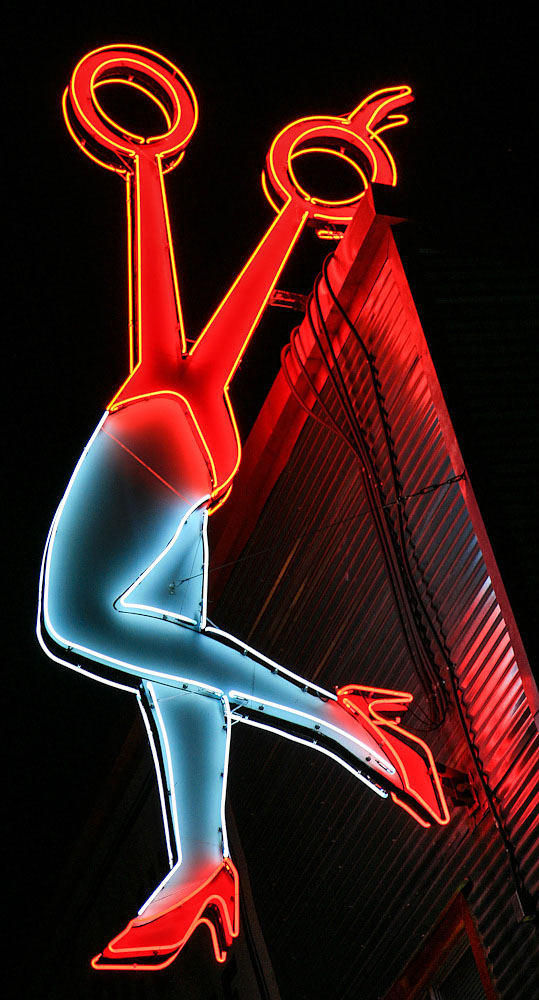



 The Rudd Motel
 The
The  New Motel
-2.jpg)
.jpg)
.jpg)