Chicago Theatre
Chicago, IL Photo by RoadsidePeek.com
The Chicago Theatre is a French Baroque style theatre located in Chicago's Loop area. According to the Chicago Theatre website, it was known as "the Wonder Theatre of the World" back when it opened in 1921.
There's a reason the Chicago Theatre is one of the most photographed landmarks in the city. Whether you're arriving by train, walking through the Loop, or simply rounding the corner onto State Street, your eyes are naturally drawn upward to the towering vertical "CHICAGO" sign and the brilliant marquee below. It's one of those places that seems larger than life, and even after seeing it countless times, it never loses its ability to impress.
When the theater opened on October 26, 1921, it was promoted as the "Wonder Theatre of the World," and that wasn't just advertising hype. Designed by the famed architectural firm of Rapp and Rapp in an elegant French Baroque style, the Chicago Theatre was built to amaze. The lavish interior, soaring lobby, and grand auditorium made moviegoing feel like a special occasion, while the enormous marquee outside announced that something extraordinary was waiting inside.
Chicago Theatre
Chicago, IL Photo by RoadsidePeek.com
In its early years, the theater offered much more than movies. Audiences came for elaborate stage productions, orchestras, vaudeville performances, and appearances by some of the biggest entertainers of the day. As tastes changed during the 1950s, the live productions gradually faded away and the theater became known primarily as one of Chicago's great movie palaces.
Like many downtown theaters across America, the Chicago Theatre struggled during the 1970s and early 1980s. Attendance declined, the neighborhood changed, and after decades of entertaining millions of visitors, the theater finally closed its doors in September 1985. For a brief time, demolition seemed like a real possibility, and Chicago came dangerously close to losing one of its architectural treasures.
Close-up of the Chicago marquee Chicago, IL Photo courtesy Richard Weiss
Fortunately, preservationists, the City of Chicago, and the Chicago Theatre Restoration Associates stepped in to save the landmark. Following an extensive restoration, the theater reopened in September 1986 with Frank Sinatra taking the stage. It was a symbolic choice, as Sinatra had performed there during the theater's golden years, linking its celebrated past with its promising future.
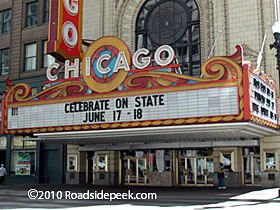
Close-up of Chicago Marquee in day
Chicago, IL Photo by RoadsidePeek.com
Of course, the theater's biggest star may be the marquee itself. The six-story vertical neon sign has become one of the defining images of Chicago, appearing in countless photographs, postcards, travel guides, and souvenirs. It has also made appearances in numerous films and television productions, including The Blues Brothers, The Untouchables, High Fidelity, Ocean's Twelve, The Weather Man, and Public Enemies. Directors often use the glowing marquee as an instant visual cue that tells audiences exactly where the story is taking place.
The sign has become part of Chicago's identity in much the same way as Wrigley Field, the elevated trains, or the skyline along Lake Michigan. Visitors from around the world gather beneath the marquee to take photos, especially at night when the neon reflects off the surrounding buildings and fills State Street with light. It's hard to imagine downtown Chicago without it.
Interior Chicago, IL Photo courtesy Richard Weiss
More than a century after opening its doors, the Chicago Theatre continues to host world-class concerts, comedians, and live performances while preserving one of America's greatest theater marquees. For lovers of vintage signs, historic architecture, and classic Americana, few places capture the magic of old Chicago quite like this one.
Interior
Chicago, IL Photo courtesy Richard Weiss
UPDATE: The Chicago Theatre remains beautifully restored and continues to light up Chicago's Loop with its iconic marquee. 07-26
Stepping inside is every bit as impressive as standing beneath the marquee. The grand lobby was inspired by the Royal Chapel at Versailles, with sweeping staircases, crystal chandeliers, marble, bronze, and richly detailed ornamentation at nearly every turn. The auditorium continues the French Baroque theme with an ornate proscenium arch, decorative plasterwork, and a ceiling that gives the impression of looking into an endless dome. It's the kind of place where your eyes never seem to settle because there's always another architectural detail waiting to be discovered.
Part of the theater's appeal is that it still feels like a true movie palace from Hollywood's golden age. While many historic theaters were divided into multiplexes or stripped of their original character, the Chicago Theatre retained the grandeur that made it famous. Today, visitors often spend as much time admiring the interior as they do watching the performance, making the building itself one of the stars of the show.




 Chicago Theatre
 Chicago Theatre
 Close-up of the Chicago marquee
 Close-up of Chicago Marquee in day
 Interior
 Interior