Belasco Theatre
New York City, NY Photo by RoadsidePeek.com
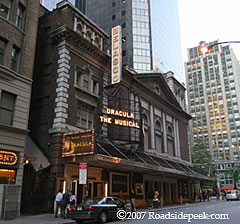
The narrow facade and tall vertical sign of the Belasco Theatre give this West 44th Street house a distinctive old Broadway appearance. The theater is also famous for its longtime reputation as one of the most haunted places in the Theater District. 05-20
The theater opened in 1907 as the Stuyvesant Theatre and was renamed for producer David Belasco in 1910. Architect George Keister designed the building, while Belasco filled the interior with elaborate murals, stained glass, and carefully controlled stage lighting.
Belasco, who was nicknamed the “Bishop of Broadway” because of his clerical-style clothing, maintained a large apartment above the auditorium. The ten-room duplex contained theatrical memorabilia and was connected to the theater by a private elevator. The Shubert Organization acquired the property in 1948.
Following Belasco’s death in 1931, performers and theater workers began reporting sightings of a man dressed in clerical clothes. His ghost is said to appear in the balcony and occasionally in a box overlooking the stage. Other stories involve footsteps and the sound of the old penthouse elevator. Broadway lore claims the sightings stopped while the risqué revue Oh! Calcutta! played here because Belasco’s ghost was offended by the production.
UPDATE: The landmark theater remains open under Shubert ownership. It is currently home to the Tony Award-winning musical Maybe Happy Ending, which played its 688th performance on July 7, 2026, becoming the longest-running production in the Belasco’s history. 08-26
Ambassador Theatre
New York City, NY Photo by RoadsidePeek.com
Here are a couple of looks at the Ambassador Theatre, another one of those Broadway houses tucked into the busy streets around Times Square. The tall vertical sign and old-fashioned marquee are the real attention getters along West 49th Street. One view catches the full front of the theater, while the closer shot shows off the Ambassador lettering and all those lights waiting for nighttime. 05-20
The Ambassador opened on February 11, 1921, with the musical The Rose Girl. It was designed by Herbert J. Krapp, the architect responsible for quite a few of Broadway’s familiar theaters. This one presented him with a problem. The lot was a tight 100-foot square, which was not exactly ideal for squeezing in a profitable Broadway audience.
Krapp’s answer was to turn the entire auditorium diagonally inside the building. That unusual arrangement created a hexagonal theater and placed many of the seats surprisingly close to the stage. It is a clever bit of design hidden behind a fairly plain brick front. Nothing outside gives away the odd shape waiting on the other side of the doors.
Ambassador Theatre front view
New York City, NY Photo by RoadsidePeek.com
The Ambassador did not spend its entire life as a Broadway theater. After the Shuberts sold it during the Depression, it operated for a time as a movie house and later became the Ambassador Tele-Theatre. NBC and the DuMont Television Network both used the building as a television studio. The Shuberts bought it back in 1956, fixed up the interior, and returned it to live theater.
Over the years, the Ambassador has hosted everything from musicals and comedies to television cameras. Its unusual auditorium was designated a New York City interior landmark in 1987. Not bad for a theater that had to be turned sideways just to fit onto its lot.
UPDATE: The Ambassador remains open under Shubert ownership, and its vertical sign and marquee are still lighting up West 49th Street. The revival of Chicago moved into the theater in 2003 and is still serving up all that jazz more than two decades later. It is the longest-running musical revival and the longest-running American musical in Broadway history. 08-26
Orpheum Theater
Boston, MA
Photo by RoadsidePeek.com
Tucked down Hamilton Place is the Orpheum Theatre, one of Boston’s oldest entertainment halls. The entrance shown here was once an alley, which helps explain why this historic theater can be so easy to miss. Just look for the Orpheum name across the canopy. 11-20
The building opened in 1852 as the Boston Music Hall and became the original home of the Boston Symphony Orchestra in 1881. It was later remodeled for vaudeville and became the Orpheum Theatre in 1906. Loew’s acquired it a few years later.
The original grand entrance faced Washington Street, but that space was converted into retail shops. Since then, crowds have entered through the narrow Hamilton Place entrance. The Police recorded part of their Live! album here in 1979, and U2 played a memorable radio-broadcast concert in 1983.
UPDATE: The Orpheum remains open as a live music venue, with its hidden-away entrance and illuminated canopy still welcoming concertgoers. 08-26



 Belasco Theatre
 Ambassador Theatre
 Ambassador Theatre front view
 Orpheum Theater