Who's Hobby House
Rapid City, SD Photo courtesy Don Gardner
You can't help but notice the big neon owl keeping watch over Main Street. The sign at Who's Hobby House has been turning heads since 1951, complete with a clever play on words based on founder William H. Osterburg's initials—W.H.O. The wide-eyed owl seems to stare at every passing traveler, making it one of Rapid City's best-known roadside signs.
The hobby shop opened in 1950 and quickly became a favorite stop for anyone interested in model trains, airplanes, plastic models, and just about every other hobby imaginable. The Kingsbury family took over the business in 1959 and has continued the tradition for generations, making it one of downtown Rapid City's longest-running family-owned businesses.
While the store is a destination for hobbyists, it's the owl that most people remember. Character signs like this have become increasingly rare, and this one has been welcoming customers for more than 70 years. It's easy to see why it's become a favorite stop for neon fans and road trippers exploring downtown Rapid City. 06-08
Who's Hobby House
Rapid City, SD Photo courtesy Lee Salawitch
UPDATE: Who's Hobby House in Rapid City doesn't only feature a great play on words with its name but also still has a fully working neon sign. This updated photos is from June 2008. According to the Who's Hobby House website, the store moved to their current downtown Rapid City location in 1993. Who's Hobby House originally was founded in 1950 by William H. Ostertag, whose initials are where the name "Who's" originated from. The sign was made in 1951. Many thanks to Lee Salawitch for photo update. 04-09
UPDATE: Who's Hobby House remains family owned and celebrated its 75th anniversary in 2025. The shop continues to operate from its longtime downtown location, and its iconic 1951 neon owl remains one of Rapid City's most recognizable commercial signs. 06-26
Grain Belt Beer
Minneapolis, MN Photo courtesy Matthew Hands
It's hard to miss the giant bottle cap floating above the Mississippi River. The famous Grain Belt Beer sign has been a Minneapolis landmark since 1941, and its clever artwork creates the illusion that the bottle cap is actually projecting outward from the sign. It's one of those roadside designs that makes you look twice.
The porcelain-faced sign was originally installed atop the Marigold Ballroom on Nicollet Avenue before being moved to Nicollet Island in 1950. Measuring roughly 50 feet wide and 40 feet tall, it quickly became one of the most recognizable advertising signs in the Twin Cities, greeting motorists and pedestrians crossing the nearby Hennepin Avenue Bridge.
Although Grain Belt beer was originally brewed in Minneapolis, the sign outlived the city's brewing industry and remained a familiar part of the skyline long after the brewery closed. Today it's as much a Minneapolis landmark as it is an advertisement, drawing photographers and road trippers who come to admire one of the Midwest's classic signs. 08-17
UPDATE: After years of sitting dark, the Grain Belt sign underwent a major restoration following its listing on the National Register of Historic Places in 2016. It was relit in late 2017 using LED lighting designed to replicate the original neon appearance, ensuring this Minneapolis landmark will continue lighting up the skyline for years to come. 06-26
Nate's Clothing (Closed)
Minneapolis, MN Photo courtesy Matthew Hands
Here's an old vintage sign for Nate's Clothing, where "Fashion Is First!" Hey, that's a jingle! For decades, the green-and-white neon marquee welcomed downtown shoppers looking for a new suit, sport coat, or just a little help looking sharp. It became one of the most recognizable storefront signs in Minneapolis.
Founded in 1916 by Nathan Witebsky, Nate's Clothing built a loyal following by offering quality menswear at reasonable prices. The family-owned business spent generations serving Twin Cities customers, while its projecting neon sign became a familiar sight for anyone walking along North 4th Street.
Independent clothing stores like Nate's were once a fixture of downtown business districts across America. Long before shopping malls and big-box retailers, stores like this helped generations of young men pick out everything from their first interview suit to wedding attire. 08-17
UPDATE: Nate's Clothing closed in 2008 after more than 90 years in business. The familiar green-and-white neon sign was removed, but a faded ghost sign remains on the side of the neighboring Robitshek Building, offering one last reminder of a longtime Minneapolis institution where, as the slogan promised, "Fashion Is First!" 06-26
Wyman Building
Minneapolis, MN Photo courtesy Matthew Hands
Here's a photo of the Wyman Building in Minneapolis. Check out the contrast of the black letters on the white background. Okay, I'm reaching here.
Completed in 1896, the Wyman Building originally served as the headquarters and warehouse for Wyman, Partridge & Company, once the largest wholesale dry goods business north of Chicago. Designed by the Minneapolis architectural firm of Long and Kees, the handsome seven-story building has remained a fixture of the city's Warehouse District for well over a century.
One of its more interesting claims to fame came in 1910, when an addition behind the building was connected by enclosed bridges spanning the alley. Those bridges are widely credited as the first enclosed skyways in Minneapolis, kicking off a concept that would eventually grow into the city's famous skyway system.
Today the building is appreciated as much for its architecture as its history. The bold Wyman lettering still catches your eye from the street, serving as a reminder of Minneapolis' days as one of the nation's busiest wholesale and warehouse centers. 08-17
UPDATE: The Wyman Building remains beautifully preserved and continues to serve as office space within the Minneapolis Warehouse Historic District. After spending years as a home for artists' studios and galleries, the building has been restored while retaining many of its original architectural details, including the familiar Wyman name that still overlooks downtown. 06-26
Case
Belle Plaine, IA Photo courtesy Don Gardner
This vintage Case sign still stands guard over Belle Plaine. Ever wonder what the bird has to do with the sign? It's actually "Old Abe," a real bald eagle that served as the mascot of a Wisconsin regiment during the Civil War and was named in honor of President Abraham Lincoln.
J.I. Case founder Jerome Increase Case was so impressed by the eagle's story that he adopted Old Abe as the company's trademark after the war. Before long, the eagle perched atop a globe became one of the most recognizable symbols in American agriculture, appearing on tractors, threshing machines, and Case dealership signs across the country.
Today, signs like this are becoming increasingly hard to find. Even for folks who have never driven a Case tractor, the familiar eagle still evokes a time when every farm town had its own equipment dealer proudly displaying one of these colorful roadside markers. 08-17
UPDATE: The historic Case sign remains standing along Highway 21 in Belle Plaine. Although the sign shows its age after decades of exposure to the Iowa weather, Old Abe continues to keep watch over the town, making this a favorite stop for roadside photographers and tractor enthusiasts alike. 06-26
Bell's Amusement Park (Gone)
Tulsa, OK Photo courtesy Steve Felder
A traditional amusement park loved by generations of Oklahomans, Bell's Amusement Park had one of the more unusual entrance signs around. Instead of standing by itself, the glowing Bell's marquee was mounted directly onto the wooden framework of the park's famous Zingo roller coaster. It made for one unforgettable welcome.
Opened in 1968 at Tulsa's Expo Square, Zingo was designed by legendary coaster engineer John C. Allen and quickly became the park's signature attraction. Rising above 21st Street, the massive wooden coaster could be seen from blocks away, with the Bell's sign glowing from its side.
While you were there, one of the best sights was Bell's after dark. Thousands of lights illuminated the midway, the Ferris wheel, and Zingo, creating the kind of summer night memories that still bring a smile to longtime Tulsans. 08-17
UPDATE: Bell's Amusement Park closed after the 2006 season when its lease at Expo Square was not renewed. The Zingo roller coaster and its distinctive sign were dismantled, and the site was redeveloped for fairgrounds parking. Although plans to build a new Bell's in Broken Arrow were announced years later, the project never came to fruition. For many Tulsans, however, Bell's remains one of the city's most cherished memories. 06-26


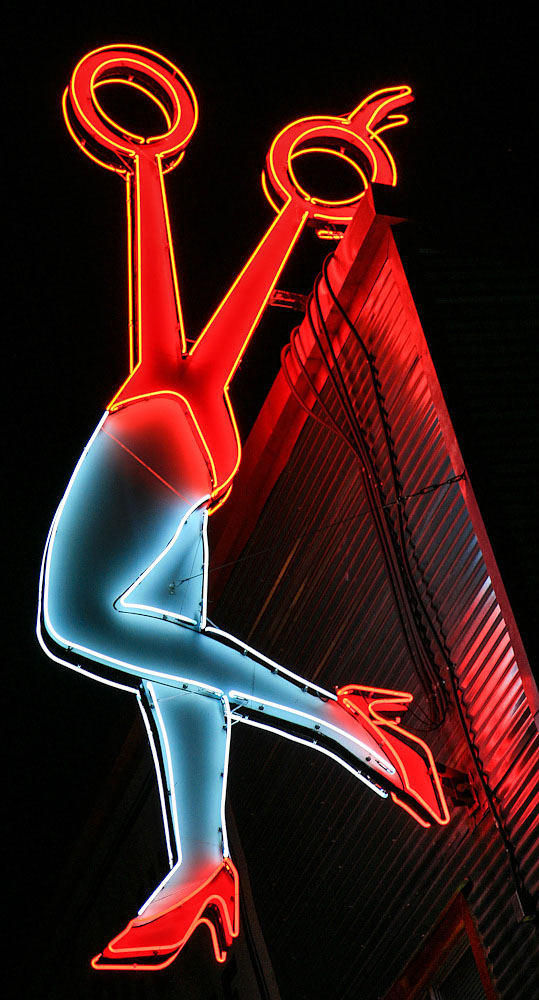
 Who's Hobby House
 While the store is a destination for hobbyists, it's the owl that most people remember. Character signs like this have become increasingly rare, and this one has been welcoming customers for more than 70 years. It's easy to see why it's become a favorite stop for neon fans and road trippers exploring downtown Rapid City. 06-08
  Grain Belt Beer
 Nate's Clothing (Closed)
 Wyman Building
 Case
Case