Phoenix Title and Trust (Closed) Phoenix Title and Trust (Closed)
Phoenix, AZ
Photo courtesy Gorb70
Here’s the former Phoenix Title and Trust Building, an 11-story Art Deco landmark in downtown Phoenix. Construction began in 1929, but the building did not officially open until January 1931. At the time, it was the largest commercial office building in Arizona. 03-06
Architects Lescher & Mahoney gave the tower a clever little visual trick. Its specially made bricks become progressively lighter toward the top, helping the building appear even taller. A large neon “Phoenix Title & Trust Co.” sign once added another bright touch to the north side.
Movie fans have unknowingly seen the view from its roof. The opening shot of Alfred Hitchcock’s Psycho was filmed here, panning across downtown Phoenix before moving toward a window in the now-demolished Jefferson Hotel.
UPDATE: The former office tower has been converted into the 90-unit Orpheum Lofts. The original lobby, marble, elevator fronts and brass mailboxes were preserved, but the large Phoenix Title and Trust neon sign is gone. 09-26
 Bowie Welcome Sign Bowie Welcome Sign
Bowie, AZ
Photo courtesy Gorb70
Welcome to Bowie, where an old storage tank doubles as the town’s greeting sign. The hand-painted message faces travelers entering along the old highway loop and provides a simple bit of roadside character. Nothing too fancy here, but it gets the job done. 03-06
Bowie was once a busy stop along old US Route 80. After Interstate 10 bypassed the business district, traffic through town slowed considerably, leaving the old highway much quieter than it had been.
UPDATE: The Welcome to Bowie tank and its painted lettering still survive near the entrance to town. The exact age of the sign remains unknown. 09-26
 Amerind Foundation Amerind Foundation
Dragoon,
AZ
Photo courtesy Gorb70
Tucked among the giant granite boulders of Texas Canyon is the Amerind Foundation and Museum. The Spanish Colonial buildings, red tile roofs and desert surroundings give the place the feeling of an old secluded ranch. It is an impressive setting for a museum devoted to the Indigenous cultures and archaeology of the Americas. 02-07
William Shirley Fulton first purchased the property in 1930 after hearing that prehistoric farming villages could be found among the boulders. He built a home on the ranch the following year and established the nonprofit Amerind Foundation in 1937. The name “Amerind” was created by combining the words “American” and “Indian.”
Tucson architect Merritt Starkweather, who also designed the Arizona Inn, planned the museum campus. Built in stages from the 1930s through the 1950s, its Spanish Colonial Revival buildings include touches of Mediterranean and Moorish design. Somehow all that formal architecture looks right at home among the giant rocks.
 Amerind Foundation Amerind Foundation
Dragoon,
AZ
Photo courtesy Gorb70
The museum preserves archaeological and cultural materials representing Native peoples from the Arctic to South America, with exhibits reaching from the Ice Age to the present. The Fulton-Hayden Memorial Art Gallery, added in 1959, displays Western art along with changing exhibitions by contemporary Native artists.
The Amerind Foundation and Museum in Dragoon, AZ was founded in 1937 by William S. Fulton.
The grounds are also part of the experience. The surrounding Texas Canyon Nature Preserve offers more than eight miles of trails winding through the boulders and high-desert landscape. Not a bad bonus after spending a few hours inside the museum.
UPDATE: The Amerind Foundation remains open as a museum, archaeological research center, art gallery and nature preserve. Its historic buildings and collections continue to welcome visitors to Texas Canyon. 09-26 |
 Rialto Building Rialto Building
Tucson, AZ
Photo courtesy Gorb70
The Rialto Building and Theatre opened along Congress Street in 1920, not 1900 as an old photo caption once claimed. The complex combined ground-floor shops, upstairs apartments and one of Tucson’s first movie theaters beneath a Spanish-style tile roofline. 04-07
The Rialto also hosted vaudeville, with Ginger Rogers among the performers who appeared on its stage. After later operating as the Paramount and El Cine Plaza, the neglected theater was rescued and reopened in 1996.
UPDATE: The Rialto remains active as a popular live-music venue. The theater and neighboring commercial building were both added to the National Register of Historic Places in 2003. 09-26
 Julian Drew Building Julian Drew Building
Tucson, AZ
Photo courtesy Gorb70
The Julian-Drew Building has been part of downtown Tucson since 1917. Its brick exterior, tall storefront windows and simple Neoclassical details give the corner a sturdy early commercial look. A faded Lewis Hotel sign still provides a clue to what once waited upstairs. 04-07
The building was commissioned by businessmen William Armine Julian and W.E. Drew. The first floor included a plumbing business and an automobile showroom for the Tucson Overland Company. Those big windows were designed to put the latest cars on display at a time when indoor dealerships were still a fairly new idea in Southern Arizona.
The entire second floor became the Lewis Hotel, giving downtown visitors a place to stay directly above the shops. The building was added to the National Register of Historic Places in 1996.
UPDATE: The former hotel rooms have been renovated as the Julian Drew Lofts. The old automobile showroom downstairs is now home to Charro Steak & Del Rey, operated by the family behind Tucson’s historic El Charro Café. 09-26
 Indian Village Trading Post (Closed) Indian Village Trading Post (Closed)
Tucson, AZ
Photos courtesy Gorb70
The Indian Village Trading Post had been part of downtown Tucson for so long that its crowded windows and old storefront seemed to belong on Congress Street. Native American art, jewelry, pottery and souvenirs filled the shop, which had occupied this corner since at least the early 1950s. The building itself was even older, dating all the way back to 1897. 04-07
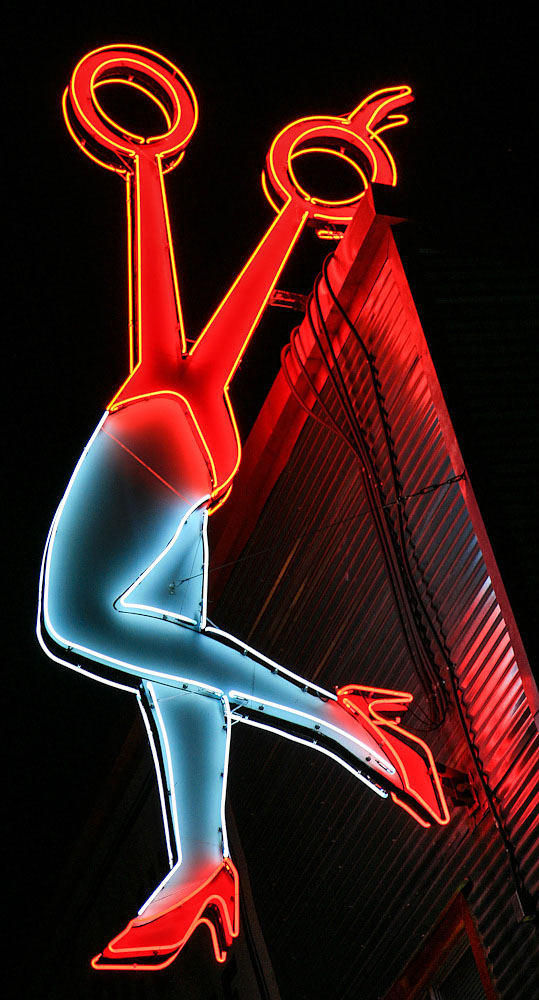
The trading post once had a 10-foot neon Native American figure dancing above the storefront, but that sign was removed in 1986. By 2007, the shop was preparing to leave as developers talked about replacing the surrounding property with condominiums and an upscale restaurant. A smaller location at colorful La Placita Village was announced as its new home.
Those plans did not move nearly as quickly as expected. The condominium project stalled, and the Indian Village continued operating on Congress Street until June 2012. After the shop finally departed, the old building sat empty and deteriorating while one downtown redevelopment idea after another came and went.
 La Placita Village La Placita Village
Tucson, AZ
Photos courtesy Gorb70
La Placita Village had its own complicated history. The brightly painted office and shopping complex was built during the 1970s on land cleared by an urban renewal project that displaced much of an older Mexican-American neighborhood. La Placita was demolished in 2018 and replaced by The Flin apartments, although three historic adobe buildings on the property were saved.
The Indian Village building found a better ending. Rio Nuevo purchased it in 2023 and began a major historical restoration. Workers uncovered its red brick and lava-rock walls, restored the tall storefront windows and adapted the long-vacant rooms for a new restaurant.
UPDATE: The former Indian Village Trading Post has reopened as a multi-level Cornish Pasty Co. restaurant with an open kitchen, basement wine lounge and upstairs bars. The 1897 building survives, but the old trading post signs are gone. 09-26 |
|