At night the roadside landscape can be a beautiful scene. Imagine a boulevard
full of roadside motels lighting up their marquees as the sun sets, one
by one.
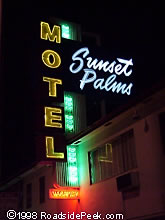
Sunset Palms Motel (Gone)
Hollywood, CA Photo by RoadsidePeek.com
The Sunset Palms Motel glows at night for those passing down Sunset
Boulevard. Although the streets have been cleaned up quite a bit from
a couple of decades ago, small treasures such as this one still light
the memory of Sunset Boulevard's past.
Its early history included a Hollywood vice-squad raid in 1955 and the death of German scientist Edward Roka in one of the rooms in 1958. Those incidents became part of the property’s darker history, far removed from the cheerful promises of its travel advertising.
The motel subsequently operated as the Hollywood Studio Inn & Suites before taking on a different purpose.
Oasis Motel (Demolished)
Anaheim, CA Photo courtesy Georg Balandran
Orange County is home to a couple of theme parks. With them come tourists
in search of sleeping accommodations. To catch their eye, good unique neon
signage can still be spotted off the road at times.
Palm trees and a glowing roadside marquee once greeted travelers at the Oasis Motel along Beach Boulevard in Anaheim. Opened in the mid-1950s, this motor court belonged to the wave of lodging that welcomed families visiting Orange County’s growing attractions.
The low-slung buildings and tropical landscaping offered the familiar promise of a comfortable roadside stop. Its vertical neon sign helped motorists pick out the property among the many motels competing for attention along State Route 39.
UPDATE: The Oasis Motel closed and was demolished in 2002. Later accounts described the cleared site as a weedy lot with some of its old palm trees still standing, a quiet reminder of the motel that once surrounded them. 10-26
Bayshore Inn Motel
Ventura, CA Photo by RoadsidePeek.com
Traveling through Ventura, check out the marquee at the Bayshore Inn Motel on East Main Street. Script lettering and sharp geometric arrows give the sign plenty of roadside character, with the neon adding another reason to pass by after dark.
Established in the late 1950s, the 24-room motel served motorists traveling the coast between Los Angeles and Santa Barbara. Its two-story layout offered an overnight stop in town without the scale of a large resort hotel.
The sign became a favorite subject for vintage roadside photographers. While guests looked for the office, sign hunters had something else to admire above the driveway. The arrows could point the way for both.
UPDATE: The Bayshore Inn remains in operation at 3075 E. Main Street. Interior updates have kept the coastal motel in use, continuing a lodging history that began in the late 1950s. 10-26
Half Moon Motel (Gone)
Culver City, CA Photo by RoadsidePeek.com
The Half Moon Motel brightens up the sky here. This is one of
the first neon photos ever posted to Roadside Peek. Against the evening sky, the neon gave this Sepulveda Boulevard stop a memorable appearance without requiring much explanation of the name.
Opened in 1955, the motel served travelers moving through the Westside, including visitors headed toward the coast, nearby studios, and Los Angeles International Airport. Its marquee became the feature that roadside photographers remembered long after passing the rooms below.
New ownership brought a substantial renovation in 2016. The property became the Galaxy Inn, trading its familiar motel identity for a more contemporary appearance. The crescent marquee came down during the changes.
UPDATE: The former Half Moon Motel survives as the Galaxy Inn at 3958 Sepulveda Boulevard. The removed neon sign was reportedly rescued into a private desert art collection. 10-26
Silver Saddle Motel North Hollywood, CA Photo by RoadsidePeek.com
A glowing saddle gave the Silver Saddle Motel in North Hollywood a fitting roadside identity. The tall marquee and its red-and-green neon lettering brought a little Western flavor to the drive along Lankershim Boulevard.
Opened around 1954–1955, the motel advertised deluxe kitchens, air conditioning, carpeted rooms, and a large outdoor swimming pool. Early postcards showed palms and a native-stone wall around the pool, giving travelers a vacation setting in the growing San Fernando Valley.
The pool was later filled in, and alterations changed portions of the property. The motel nevertheless escaped demolition, keeping its place along the old commercial corridor.
UPDATE: The Silver Saddle Motel remains in operation at 6235 Lankershim Boulevard. Its historic saddle marquee is reported to continue lighting up for nighttime travelers. 10-26
Topper Motel (Gone)
Studio City, CA Photo by RoadsidePeek.com
A giant neon top hat once greeted motorists at the Topper Motel in Studio City. Its sequential lighting made the hat appear to tip or flash, offering a rather dapper welcome along Ventura Boulevard.
Established as a motor court in the late 1930s, the property expanded in 1947 into a 70-room motel with steam heat and a swimming pool. In 1950, rooms were advertised for $3 a night. The oversized hat gave travelers a landmark to remember, even if they weren’t stopping overnight.
UPDATE: Later renovations removed the neon top hat and themed details. The former Topper operates as the Studio City Inn at 11733 Ventura Boulevard, continuing its long history of roadside lodging. 10-26
Palm Motel (Demolished)
South Bay, CA Photo by RoadsidePeek.com
Neon palm fronds once advertised the Palm Motel in the South Bay area. Built in the mid-1950s, the 20-room motor court offered travelers a small roadside stop within reach of the beaches.
Its asymmetrical roofline and simple courtyard reflected the era’s motel design, while the sign supplied a little tropical atmosphere out front. A palm tree above the driveway could help put motorists in a vacation frame of mind before they reached the coast.
The property later shifted toward weekly lodging for local workers. As the buildings aged, the old motor court became a candidate for redevelopment.
UPDATE: The Palm Motel was reportedly demolished during the 2010s and replaced by multifamily housing. Some doors and plumbing fixtures were salvaged before clearance, though an exact demolition year was not supplied. 10-26





 Bayshore Inn Motel
 Half Moon Motel (Gone)
 Silver Saddle Motel
 Topper Motel (Gone)
 Palm Motel (Demolished)