Motown Historical Museum
Detroit, MI Photo courtesy Richard Weiss
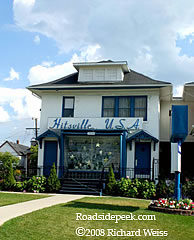
Here is the Motown Historical Museum on Grand Blvd., which is almost in the shadow of the massive Albert Kahn designed General Motors Building (now Cadillac place) in Detroit, MI.
Hitsvile USA. Home to the Temptations, Supremes, Smokey Robinson and the Miracles,
Annheuser-Busch (Demolished)
Detroit, MI Photo courtesy Richard Weiss
Here is a small Anheuser-Busch building on Jefferson, just east of the Ambassador Bridge in Detroit. The building is simple but elegant and the Anheuser-Busch logo overhead did not hurt. It always seemed to be the perfect subject for a HO Scale model railroad structure kit. The first three pictures were taken on a cold overcast February 1986. About four years ago, someone had stolen (Or purchased?) the carved Anheuser-Busch logo. This building has now shown up in the list of Detroit buildings scheduled for demolition in 2008. Many thanks to Richard Weiss for info. 07-08
Here's an old Anheuser-Busch distribution building in Detroit, MI. Long before beer was hauled around by today's fleet of tractor-trailers, brick depots like this helped get Budweiser from St. Louis to cities across the Midwest. It's a simple industrial building, but it's a neat reminder of how the brewing business operated over a century ago.
Annheuser-Busch
Detroit, MI Photo courtesy Richard Weiss
Before Prohibition, Anheuser-Busch established distribution depots in major cities where refrigerated rail cars delivered beer for local storage and delivery. From there, horse-drawn wagons carried Budweiser to taverns, restaurants, hotels, and businesses throughout the city. It was an impressive system for its time and helped the company expand well beyond its St. Louis home.
The whole operation depended on refrigeration. Adolphus Busch invested heavily in refrigerated rail cars, allowing beer to travel hundreds of miles while staying fresh. That innovation helped transform Budweiser from a regional product into a national brand.
Annheuser-Busch logo removed
Detroit, MI Photo courtesy Richard Weiss
Unlike the grand brewery in St. Louis, these branch depots were built to get the job done. They weren't tourist attractions or showpieces. Instead, they quietly handled storage, shipping, and local deliveries, making them an important link between the brewery and the neighborhood tavern.
It's easy to picture this building during its busiest days, with rail cars unloading in the yard while delivery wagons lined up outside waiting for the next shipment. Buildings like this rarely get much attention, but they played a big part in keeping America's beer flowing.
UPDATE: Unfortunately, this old distribution building is gone. The exact details surrounding its demolition aren't clear, but the structure has disappeared, leaving only old photographs to document this small piece of Detroit's brewing history. 07-26
Annheuser-Busch
Peoria, IL Photo courtesy Richard Weiss
Here's the old Anheuser-Busch Building in Peoria, IL. Sitting on a triangular corner lot, this distinctive flatiron-shaped building is hard to miss. Look up near the roofline and you'll still find "ANHEUSER-BUSCH" carved into the stone, along with the company's familiar A&Eagle logos. It's a nice reminder of the building's original purpose. 07-08
Built in 1911, the building originally served as an Anheuser-Busch "tied house," a brewery-owned saloon that helped promote and distribute Budweiser in the days before Prohibition. At the time, Peoria was a major brewing and distilling city, making it a natural place for the company to establish a presence.
Over the years, the building found plenty of new uses. It became the Kickapoo Hotel, housed restaurants and shops, and even had a Shell gas station tucked into the narrow rear portion of the property. By the time this photo was taken, that drive-through area was being used by a dry cleaner. It's not every day you find a building that has been a saloon, hotel, gas station, and cleaners all in one lifetime.
The flatiron design is what really makes this one stand out. It's the only building of its kind in central Illinois, and no matter what business has occupied the space over the years, the architecture has always stolen the show.
UPDATE: The building has been beautifully restored and is now home to a coffee shop on the first floor with apartments above. The historic stone Anheuser-Busch name and A&Eagle medallions still survive, making this one of Peoria's most recognizable historic commercial buildings. 07-26
Forum Building
Quincy, IN Photo courtesy Richard Weiss
Here's the old Forum Building in Quincy, IL. One of the first things you'll notice is the word "FORUM" carved into the stone facade. It's not something you see every day, and it certainly makes you wonder what the story is behind the name. 09-08
The building began life in 1876 as the headquarters for Ricker National Bank, with a matching addition built a few years later as the business expanded. Designed by Chicago architect John S. McKean, the impressive brick and stone building has remained one of downtown Quincy's architectural highlights ever since.
While many people know it today as the Forum Building, the name became even more familiar during the 1980s when the building was converted into a popular nightclub known simply as The Forum. For years it was a favorite downtown gathering spot before taking on yet another role.
It's always fun when a building leaves behind little clues like the engraved stonework. Even if you didn't know its history, those large "FORUM" carvings are enough to make you stop and take a closer look.
UPDATE: The building has been beautifully preserved and now operates as The Corinthian Event Center. The historic facade and its distinctive "FORUM" engravings remain intact, so it's still easy to spot while exploring downtown Quincy. 07-26
S.J. Lesem Bros. Building
Quincy, IN Photo courtesy Richard Weiss
Here's the S.J. Lesem Building in Quincy, IL. This handsome Italianate commercial building has been watching over Third Street since 1871 and is one of the last reminders of the city's old Wholesale Row. With its tall arched windows, decorative brickwork, and cast iron details, it's easy to see why it catches your eye. 09-08
The building was constructed for S.J. Lesem Brothers and Company, a successful wholesale dry goods business that helped supply merchants throughout the region. At the time, this part of downtown was filled with warehouses and wholesale businesses serving river and rail traffic.
Over the years, the building found new life, including many decades as home to the Quincy Casket Company. Fortunately, it survived while the rest of the buildings on the block gradually disappeared, leaving it as the lone survivor of the old Wholesale Row district.
UPDATE: The building has been beautifully preserved and is listed on the National Register of Historic Places. The upper floors have been converted into lofts, while the first floor is home to a restaurant, ensuring this old Wholesale Row survivor remains an active part of downtown Quincy. 07-26



 Annheuser-Busch (Demolished)
 Annheuser-Busch
 Annheuser-Busch logo removed
 Annheuser-Busch
 Forum Building
 S.J. Lesem Bros. Building