Zinke's Drive-in (Rem.)
Pasadena, CA Photo by RoadsidePeek.com
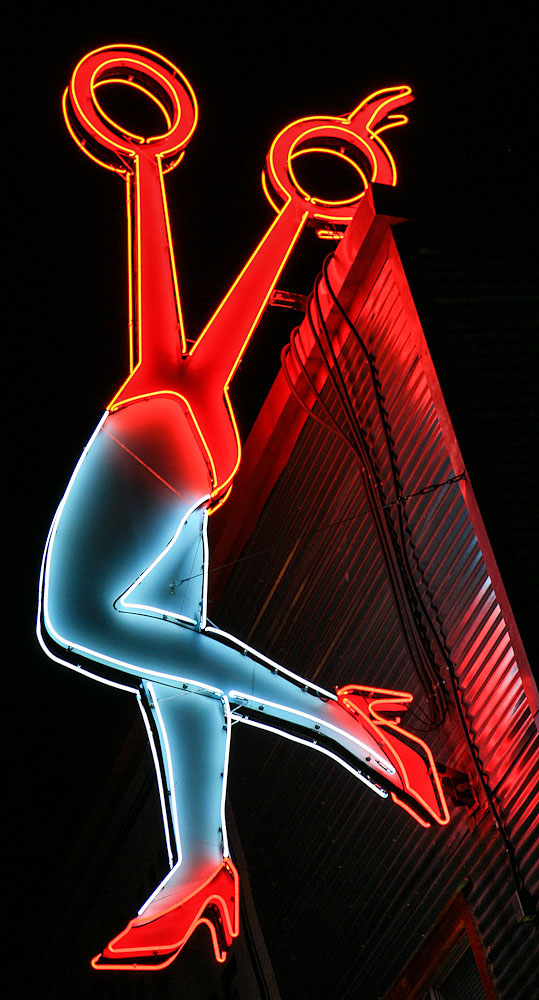
The neon for Zinke’s Drive-In might suggest a hamburger and a shake, but this Pasadena sign advertised something else entirely: shoe repair. The drive-in name referred to the convenience of dropping off footwear, giving the family car a role in getting a worn pair of shoes back into shape.
The Zinke’s business dates to 1919, and its Pasadena neon became a familiar part of the Colorado Boulevard streetscape. Even without a restaurant underneath, the sign offers plenty of the roadside appeal associated with the drive-in era.
UPDATE: Pasadena’s historic Zinke’s sign dates to 1948 and is recognized as a contributor to the Pasadena Playhouse Historic District. The Zinke’s sign preserved at the Museum of Neon Art came from a separate Glendale location. 10-26
Oaks Pharmacy (Demolished)
Pasadena, CA Photo by RoadsidePeek.com
It’s always a shame to see a familiar roadside treasure disappear, especially when neon is involved. Add a location along a historic alignment of Route 66, and the loss becomes a little harder to take. Cal
Oaks Pharmacy in Pasadena was one of those neighborhood stops, with its glowing sign adding character to the corner of California Boulevard and Fair Oaks Avenue. 03-05
The pharmacy belonged to the everyday side of the old highway, where residents stopped for prescriptions, small purchases, and a familiar face behind the counter. Alongside the nearby service station and liquor store, it helped make this a working neighborhood corner rather than simply another intersection to pass through.
Oaks Pharmacy (Demolished)
Pasadena, CA Photo by RoadsidePeek.com
For roadside watchers, the neon supplied another reason to notice a building that might otherwise have seemed like an ordinary part of the neighborhood. Once illuminated, the lettering gave the storefront a presence of its own. These smaller commercial signs were as much a part of the Route 66 landscape as the larger motel marquees and restaurant displays farther down the road.
UPDATE: The old Cal-Oaks Pharmacy building and its neon signage were lost to demolition during redevelopment of the corner. The pharmacy name continued at another location, but the familiar Route 66 storefront pictured here is gone. Another everyday stop along the old highway has become a place to revisit through photographs. 10-26
Cross Roads of the World
Hollywood, CA Photo courtesy Devil Doll
There’s more to Cross Roads of the World than its familiar globe-topped tower. These views concentrate on the neon closer to the sidewalk, where a bright marquee and flowing script lettering offer another introduction to the Hollywood landmark. After dark, the signs are attractions in their own right, even without the tower filling the frame. 03-06
Opened in 1936 and designed by Robert V. Derrah, the complex brought an ocean-liner-shaped building together with a collection of internationally styled storefronts. The idea was to make a shopping trip feel a little like traveling abroad, all without leaving Sunset Boulevard. Visitors could wander among the different architectural settings, with the central “ship” providing an especially unusual neighborhood landmark.
The neon helped announce this little world to motorists outside. While the tower and rotating globe drew attention from farther away, the sidewalk signage offered details worth slowing down to appreciate. The script lettering adds a softer flourish alongside the more prominent marquee, giving sign hunters more than one composition to work with.
Cross Roads of the World
Hollywood, CA Photo courtesy Devil Doll
The property later became better known for creative offices, with writers, music businesses, and film-related tenants occupying its unusual spaces. Its appearance in L.A. Confidential added another screen credit to a place already closely tied to Hollywood.
UPDATE: Cross Roads of the World remains a protected historic complex. Its sidewalk neon and script signage are part of the distinctive setting surrounding the better-known tower and globe, preserving a little of the theatrical approach that made this 1930s shopping destination stand out in the first place. 10-26
El Royale Apartments
Los Angeles, CA Photo courtesy Devil Doll
High above Rossmore Avenue, El Royale Apartments announces itself with a rooftop neon display that includes the number “450.” Apparently the building’s name alone wasn’t quite enough, so the address received some illuminated attention too. The result is a distinctive nighttime marker above this stretch of Los Angeles. 03-06
Completed in 1929, the apartment tower was designed by William Douglas Lee, whose work also included Chateau Marmont. Its elaborate blend of Spanish and French Renaissance influences gave residents a grand entrance and an exterior that stood apart from the surrounding neighborhood.
The building developed a reputation for attracting entertainment-industry residents, adding Hollywood associations to its architectural appeal. For neon hunters, though, the rooftop lettering provides an attraction that can be appreciated without an invitation upstairs.
UPDATE: El Royale continues in residential use, with its familiar rooftop sign remaining part of the Rossmore Avenue skyline. The glowing name and numerals carry on a bit of the building’s late-1920s flair. 10-26
Plaza Hotel
Los Angeles, CA Photo courtesy Dave & Debra van Hulsteyn
The rooftop neon for Plaza Hotel offers a little extra flourish above the Los Angeles streets. Flowing lettering gives the name a more elegant treatment than a plain hotel sign, while the exposed framework lifts the whole display where it can be spotted beyond the immediate storefronts below. 03-06
The Hollywood Plaza opened on Vine Street in 1925, joining the growing collection of hotels serving the film industry and its visitors. Actors, travelers, and people hoping to find their place in Hollywood passed through during the neighborhood’s busy studio and radio years.
Its dining and nightlife history included a Pig ’n Whistle café and, later, the Cinnabar. The rooftop sign carried the hotel’s name beyond the entrance, advertising accommodations to a neighborhood where glowing names became part of the skyline.
UPDATE: The former Hollywood Plaza Hotel was converted to senior housing. Its historic rooftop sign survives as a reminder of the building’s earlier hotel days near Hollywood and Vine. 10-26
Toys R Us (Gone)
Rosemead, CA Photo by RoadsidePeek.com
Here’s Geoffrey the Giraffe standing guard over Toys R Us in Rosemead. The oversized mascot made a fitting roadside lookout for a store devoted to toys, giving children something to spot before the family car even reached the parking lot. Unfortunately, this giraffe had already disappeared when the former store became a Levitz Furniture showroom. 04-06
For younger passengers, a glimpse of Geoffrey could turn an ordinary drive into an appeal for a shopping stop. The familiar character helped make the building recognizable from a distance, promising aisles of games, bicycles, dolls, and other things that probably weren’t on the day’s original shopping list. I still remember stopping here for toys and video games.
UPDATE: This Rosemead Toys R Us closed years before the chain’s nationwide 2018 liquidation. Geoffrey was removed during the earlier change of tenants, and the old toy-store display no longer stands over the property. 10-26


 Zinke's Drive-in (Rem.)