The Roxy Theatre
Hollywood, CA Photo courtesy Kirk Maillet
Here’s a nighttime look at The Roxy Theatre, one of the Sunset Strip’s best-known music stops. The glowing sign offers a familiar greeting along Sunset Boulevard, where generations of concertgoers have lined up to see established performers and artists just beginning to make a name for themselves.
Opened on September 20, 1973, by Lou Adler, Elmer Valentine, and their partners, the Roxy began with performances by Neil Young and the Santa Monica Flyers. Its intimate room went on to host acts including Bob Marley, Bruce Springsteen, and Frank Zappa, while the upstairs On the Rox became a gathering place of its own.
In 1974, the Roxy hosted the American debut of the stage musical The Rocky Horror Show. The Rocky Horror Picture Show film followed in 1975, giving this little Sunset Strip theater a place in the story of a much larger cult phenomenon.
UPDATE: The Roxy remains an active concert venue more than five decades after opening. Its familiar “Rocking R” sign has been retained in plans for newer billboard displays around the property, keeping a recognizable piece of the old Strip in view. 10-26
Gil Turner's
Hollywood, CA Photo courtesy Kirk Maillet
At the western end of the Sunset Strip, Gil Turner's Liquor Store gives passing motorists another reason to keep an eye on the storefronts after dark. The bright lettering makes the liquor store easy to pick out along the boulevard, whether the evening calls for a shopping stop or another neon photograph.
Established in 1953, the business has served neighborhood residents alongside the musicians, entertainers, and visitors drawn to this stretch of Sunset. With the Roxy and other nightlife destinations nearby, a well-stocked liquor store has certainly been in a convenient spot.
This view captures the older neon treatment, when the lettering supplied its own glow above the shop. It’s another reminder that the Strip’s nighttime scenery has always included everyday businesses alongside its famous clubs.
UPDATE: Gil Turner’s Fine Wine & Spirits remains in business on Sunset Boulevard. The storefront’s illuminated advertising has been updated over the years, changing the older neon appearance pictured here. 10-26
Pleasure Chest
West Hollywood, CA Photo courtesy Michelle K
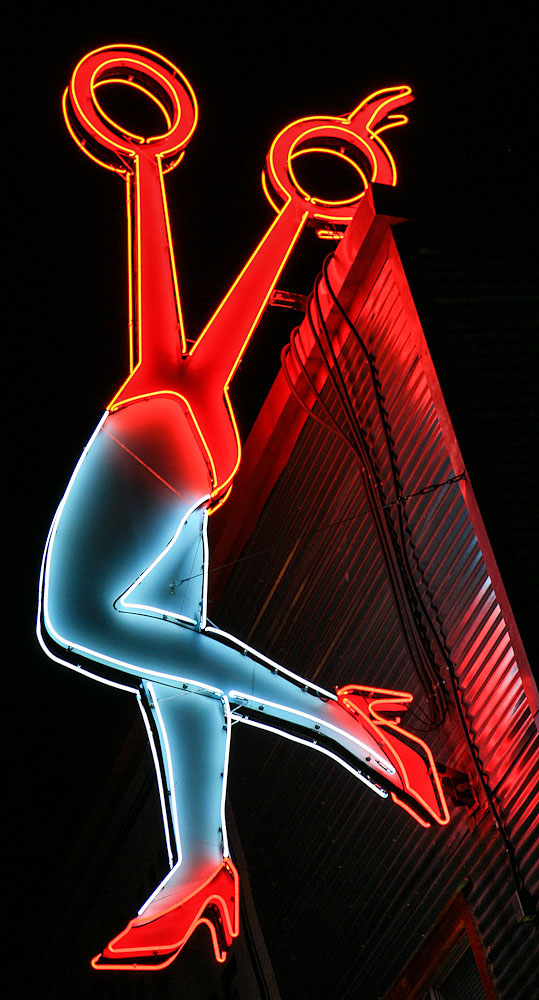
A little neon announces The Pleasure Chest along Santa Monica Boulevard in West Hollywood. The projecting sign makes the shop easy to spot after dark, adding its own glow to a boulevard known for colorful storefronts and nightlife. Whatever brings customers inside, the marquee gives passing sign watchers something to check out. 06-05
The business began in New York’s West Village in 1971 and expanded to Los Angeles in 1975, moving to its longtime West Hollywood location in 1980. It became part of the area’s counterculture and LGBTQ+ community, combining retail with an emphasis on education and an inclusive welcome.
There’s a movie connection, too. The shop supplied the costume worn by the Gimp character in Pulp Fiction, giving this neighborhood business a small part in a very recognizable Hollywood production.
UPDATE: The Pleasure Chest remains in operation on Santa Monica Boulevard, with its familiar illuminated sign continuing to advertise the shop after dark. 10-26
Hustler Hollywood
Hollywood, CA Photo courtesy Kirk Maillet
Check out the bright neon outside Hustler Hollywood, adding another conspicuous name to the Sunset Strip’s nighttime scenery. On a boulevard where businesses have long competed for attention, the shop’s illuminated lettering made sure it wasn’t overlooked.
Larry Flynt opened the original Sunset Boulevard store in 1998, combining adult merchandise, books, apparel, and a café in a setting designed to attract a broader retail audience. The storefront became a familiar part of the Strip, appearing among the clubs, restaurants, and billboards along this busy stretch.
UPDATE: Hustler Hollywood left its original Sunset Strip storefront in April 2019 and moved a short distance along Sunset Boulevard. The original exterior signage was removed during the transition, leaving this photograph as a view of the earlier location. 10-26
Yahoo (Gone)
Hollywood, CA Photo courtesy Kirk Maillet
Here’s Yahoo! making quite an impression above the roadside. The enormous illuminated name turns an internet destination into something that can be spotted without a computer, with enough neon glow to compete with the surrounding nighttime advertising.
During the dot-com years, technology companies brought a new set of names to billboards that had long advertised movies, automobiles, and drinks. Yahoo’s playful lettering was especially suited to a bright display, giving the familiar web logo a much larger presence out in the real world.
UPDATE: The old Yahoo neon display is gone. 10-26
Whisky a Go Go
Hollywood, CA Photo courtesy Kirk Maillet
A short distance from the Roxy, Whisky a Go supplies another familiar neon greeting along Sunset Boulevard. The corner marquee belongs to a club whose small stage has figured in some very large careers, giving music fans plenty to think about before they even step inside.
Opened in 1964 by Elmer Valentine and his partners, the Whisky helped popularize the go-go dancing craze in the United States. Dancers performing above the crowd became part of its identity, while live music made the room a destination beyond the dance floor.
The Whisky
Hollywood, CA Photo courtesy Michelle K
The Doors served as a house band in 1966, and the club’s history includes appearances by Led Zeppelin, the Who, and countless other performers. Later decades brought another wave of bands during the Sunset Strip’s hard-rock years, adding more names to an already crowded musical history.
UPDATE: Whisky a Go Go continues to operate on the Sunset Strip, with its familiar illuminated marquee marking the corner. More than sixty years after opening, the club remains a working music venue as well as a landmark of Los Angeles rock history. 10-26
AutoZone
Calexico, CA Photo by RoadsidePeek.com
Googie lettering, oversized marquees, and boomerang shapes helped make a simple shopping trip a little more interesting during the mid-century years. At AutoZone in Calexico, the eye-catching arrow recalls that earlier approach to roadside advertising, pointing the way with considerably more flair than an ordinary entrance sign.
The property’s former supermarket use helps explain the scale of the display. Grocery stores needed signs that could be spotted across a parking lot and read from a moving car, and this one gave the building a presence beyond its roofline. The later auto-parts use carried that roadside framework into another chapter.
UPDATE: AutoZone remains in operation along Imperial Avenue. The sign remains. 10-26


 Pleasure Chest

 Yahoo (Gone)


 AutoZone